
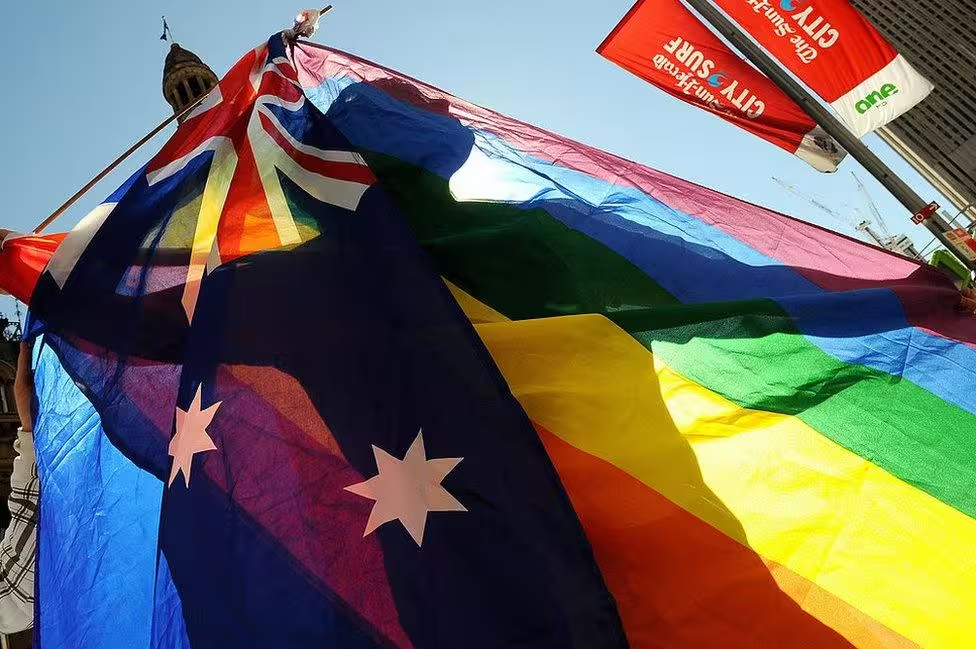
Australia has rejected all eight United Nations recommendations specifically addressing LGBTQIA+ rights during the country’s 2025 Periodic Review (UPR), drawing criticism from advocacy groups and human rights organizations.
While the Albanese government received more than 120 recommendations aimed at strengthening human rights protections across various marginalized sectors—including women, children, people with disabilities, and Aboriginal and Torres Strait Islander people—the queer community stands alone as the only group for which the government declined all proposed improvements.
Analyzing the UN Human Rights Recommendations for LGBTQIA+ Australians
During the peer-review process, eight specific recommendations were tailored to the needs of the LGBTQIA+ community. These proposals were designed to close gaps in legal protections, healthcare access, and social dignity. By refusing all eight, the government has signaled a reluctance to introduce new legislative or policy frameworks specifically targeted at these vulnerabilities.
Advocacy groups have expressed deep disappointment over the move. Savanh Tanhchareun, a spokesperson for Equality Australia, described the decision as a “missed opportunity” for the government to prove its genuine commitment to the safety and dignity of all Australians.
According to Tanhchareun, the blanket rejection suggests a perception within the government that no further progress is required for the community, despite ongoing struggles regarding visibility and legal recognition.
The tension is particularly acute given the government’s high-profile symbolic gestures. In 2023, Prime Minister Anthony Albanese made history as the first sitting Prime Minister to march in the Sydney Gay and Lesbian Mardi Gras parade, stating at the time that Australia must be a country that respects everyone for who they are. However, critics argue that symbolic participation does not equate to substantive policy reform.
Comparison of Human Rights Acceptance Rates: Albanese vs. Morrison
Data from the recent UPR reveals a troubling trend in Australia’s engagement with international human rights standards. The Albanese government accepted only 38 per cent of the total recommendations it received, totaling 128 out of 332. This marks a significant decline in cooperation compared to previous administrations.
- Current Administration: 38% acceptance rate.
- Morrison Government (2021): 51% acceptance rate.
- Global Average: Approximately 73–76% acceptance rate.
This statistical dip represents the lowest acceptance rate in the 20-year history of Australia’s participation in the UPR process.
The Australian Human Rights Commission (AHRC) has highlighted this gap, noting that the government appears to only agree to reforms that are already underway or previously implemented, effectively ignoring over 200 recommendations for new, transformative changes.
Impact on International Standing and Domestic Accountability
The decision to disregard the majority of the UNHRC’s suggestions has broader implications for Australia’s reputation as a global leader in human rights.
Dr. Anna Cody, Acting President of the AHRC, warned that the growing disparity between international commitments and domestic practice jeopardizes Australia’s standing, particularly within its own region.
Beyond the LGBTQIA+ community,
- the AHRC pointed out that the lack of response to these recommendations reflects a systemic issue regarding transparency and accountability.
- By ignoring the peer-review suggestions, the government is viewed by critics as avoiding the necessary oversight required to protect First Nations people, people in detention, and those with disabilities.
The LGBTQIA+ community has already faced internal frustrations with the administration, including criticisms over the exclusion of intersex people in the upcoming Census. These grievances, combined with the UN rejection, have created a narrative of “visible support” without “legislative action.”
Government Response to LGBTQIA+ Rights Criticisms
In response to the backlash, a government spokesperson defended the administration’s record, asserting that the Albanese Government remains steadfast in its belief that everyone deserves respect, dignity, and equality before the law regardless of their gender identity, intersex status, or sexual orientation.
The government maintains that Australia has already made “significant progress” in advancing the rights of queer Australians and remains committed to continuing that work. While they welcomed the UPR process as a whole, they maintain that the 128 accepted recommendations are the appropriate path forward for the nation’s human rights trajectory.
Frequently Asked Questions
What is the UN Universal Periodic Review (UPR)?
The Universal Periodic Review is a process conducted by the UN Human Rights Council where the human rights records of all UN member states are reviewed every four and a half years. Member states provide recommendations to one another to improve domestic human rights protections.
Why is the government’s rejection of LGBTQIA+ recommendations controversial?
It is controversial because the LGBTQIA+ community was the only marginalized group for whom the government rejected 100% of the recommendations, contradicting the government’s public image as a pro-equality administration.
How does Australia’s acceptance rate compare to other countries?
Australia’s current acceptance rate of 38% is significantly lower than the global average, where countries typically accept between 73% and 76% of the recommendations they receive.
What other human rights groups were affected by the UPR results?
While the government accepted some recommendations for women, children, people with disabilities, and First Nations people, the AHRC noted that over 200 new reforms across all these groups were essentially ignored.
What was the primary criticism from Equality Australia?
Equality Australia argued that by refusing the recommendations, the government missed a critical opportunity to demonstrate a serious commitment to the equality, safety, and dignity of LGBTQIA+ individuals.
News Sources – ABC News, Starobserver