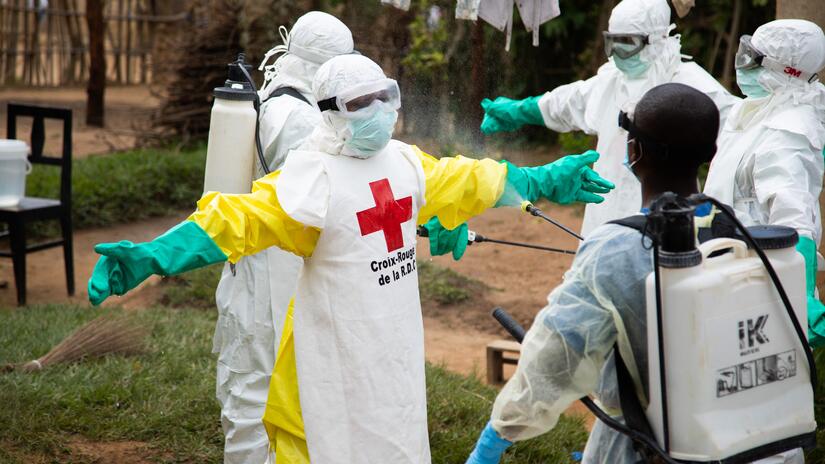
A new Ebola treatment trial has begun in the Democratic Republic of Congo (DRC) to test two experimental drugs against the Bundibugyo virus, a rare Ebola strain with no approved vaccine or treatment.
The clinical study, which began in early July 2026, aims to evaluate the efficacy of two experimental drugs against the Bundibugyo virus. The trials are centered at the Ebola treatment facility within the Evangelical Medical Center in Bunia, located in the Ituri province of eastern Congo.
This emergency research effort comes as the World Health Organization (WHO) and local health authorities report a mounting death toll and a rapid spread of the virus across several provinces. With the Bundibugyo strain exhibiting a high fatality rate, the medical community is racing to find a therapeutic intervention that can significantly improve patient survival rates.
Targeting the Bundibugyo Virus with Experimental Ebola Drugs
Unlike some other strains of the Ebola virus, the Bundibugyo species lacks a dedicated toolkit of medical countermeasures. To address this gap, the current clinical trial is testing two distinct pharmaceutical approaches, as well as a combination of both, to determine which provides the best clinical outcome for infected patients.
- Remdesivir: Developed by Gilead Sciences, this broad-acting antiviral was previously approved for the treatment of COVID-19. Laboratory tests have indicated that Remdesivir may possess the ability to combat the Bundibugyo virus.
- MBP134: An experimental treatment from Mapp Biopharmaceutical consisting of engineered antibodies specifically designed to target various Ebola viruses, including the Bundibugyo strain.
Researchers will monitor the survival of participants for 28 days following the commencement of treatment.
According to WHO research adviser Dr. Vasee Moorthy, the study could involve up to 1,000 participants. However, if one of the drugs proves to be overwhelmingly effective, the trial may reach a conclusion more quickly with fewer patients.
DR Congo Ebola Outbreak: Cases, Deaths and Global Spread
The current public health emergency began in May 2026, though experts believe the virus was circulating undetected for several weeks before the first official confirmation.
This delayed detection has contributed to the outbreak’s scale, leading the Africa CDC and U.S. public health authorities to warn that it could become one of the largest Ebola events on record.
As of July 1, the World Health Organization reported 1,460 confirmed cases and 452 deaths. Local officials in the DRC have provided slightly different figures, noting over 1,000 confirmed cases and 267 deaths.
Beyond the borders of the DRC, the virus has also been detected internationally, with 20 confirmed cases and two deaths in Uganda, and one confirmed case reported in France. There are also suspected cases being monitored in Italy and Brazil, although the Congolese government has maintained that no border restrictions will be imposed on travelers from affected areas.
Also Read – First Ebola Case Confirmed in France as Doctor Returning From DRC Tests Positive
Challenges Facing the Congo Ebola Treatment Trial
The effort to administer the Ebola treatment trial Congo is complicated by severe socio-political instability.
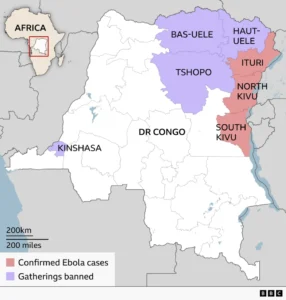
The outbreak is primarily concentrated in the eastern provinces of South Kivu, North Kivu, and Ituri. These regions are currently plagued by violent conflict, with the M23 rebel group controlling significant territories, which severely restricts the movement of health workers and the delivery of medical supplies.
In addition to the conflict, the virus is expanding into new territories. While officially restricted to three provinces, reports indicate a positive test from a deceased pregnant woman in the Tshopo province and a suspected case in the Haut-Uele province.
This has prompted authorities to ban public gatherings in Tshopo, Haut-Uele, Bas-Uele, and the capital city, Kinshasa, as a precautionary measure to prevent urban transmission.
Another significant hurdle is the prevalence of community mistrust. In Bunia, some residents have expressed fear that the experimental drugs could cause more harm than good.
Local shopkeeper Nelson Dhebi voiced a sentiment shared by some, suggesting that such research should first be tested on elected representatives. This mistrust, combined with overcrowded treatment centers and delays in patients seeking care, has led to a tragic statistic: nearly three out of four Ebola deaths in this outbreak have occurred outside of official health centers.
WHO and International Partners Expand Ebola Research
The trial is a massive international collaboration, sponsored by the WHO and coordinated by the Institut National de Recherche Biomédicale (INRB) in the DRC, the University of Oxford in the UK, and the Institute of Tropical Medicine in Belgium.
To improve the response, the Congolese Health Ministry has expanded diagnostic capabilities, increasing the number of testing laboratories from four to ten across the affected regions.
The research is designed to evolve in stages.
- The first phase focuses on patients already confirmed to have Ebola and receiving care in specialized centers.
- A second phase is planned to expand the trial to high-risk individuals, including healthcare workers and close contacts of infected patients. Professor Placide Mbala, the laboratory activities coordinator, indicates that the study could last between three and six months depending on the evolution of the outbreak.
For survivors like Gladys Munguro, who witnessed the devastation of the disease firsthand, these trials represent a necessary step toward survival. Munguro has already expressed her willingness to volunteer for the high-risk phase of the study, reflecting the hope felt by many in Bunia that these experimental therapies will provide a “light at the end of the tunnel.”
Frequently Asked Questions
What is the Bundibugyo virus?
The Bundibugyo virus is a specific species of the Ebola virus. It is highly infectious, attacks the immune system and internal organs, and is typically transmitted to humans through contact with infected animals (such as fruit bats) or the bodily fluids of infected people.
Which drugs are being tested in the Congo Ebola trials?
The trials are evaluating the antiviral drug Remdesivir, the experimental antibody treatment MBP134, and a combination of both to see if they improve the survival rate of infected patients.
Why is there no vaccine for this specific outbreak?
Vaccines for Ebola must be developed specifically for each species of the virus. Because the Bundibugyo strain is less common than others, there is currently no approved vaccine specifically tailored to it.
Where is the Ebola outbreak currently concentrated?
The outbreak is primarily concentrated in the eastern provinces of the Democratic Republic of Congo—Ituri, North Kivu, and South Kivu—though suspected cases have emerged in Tshopo and Haut-Uele provinces.
How long does it take for Ebola symptoms to appear?
The incubation period for Ebola typically ranges from 2 to 21 days. Symptoms often appear suddenly and resemble the flu or malaria, including fever, headache, and extreme tiredness.