
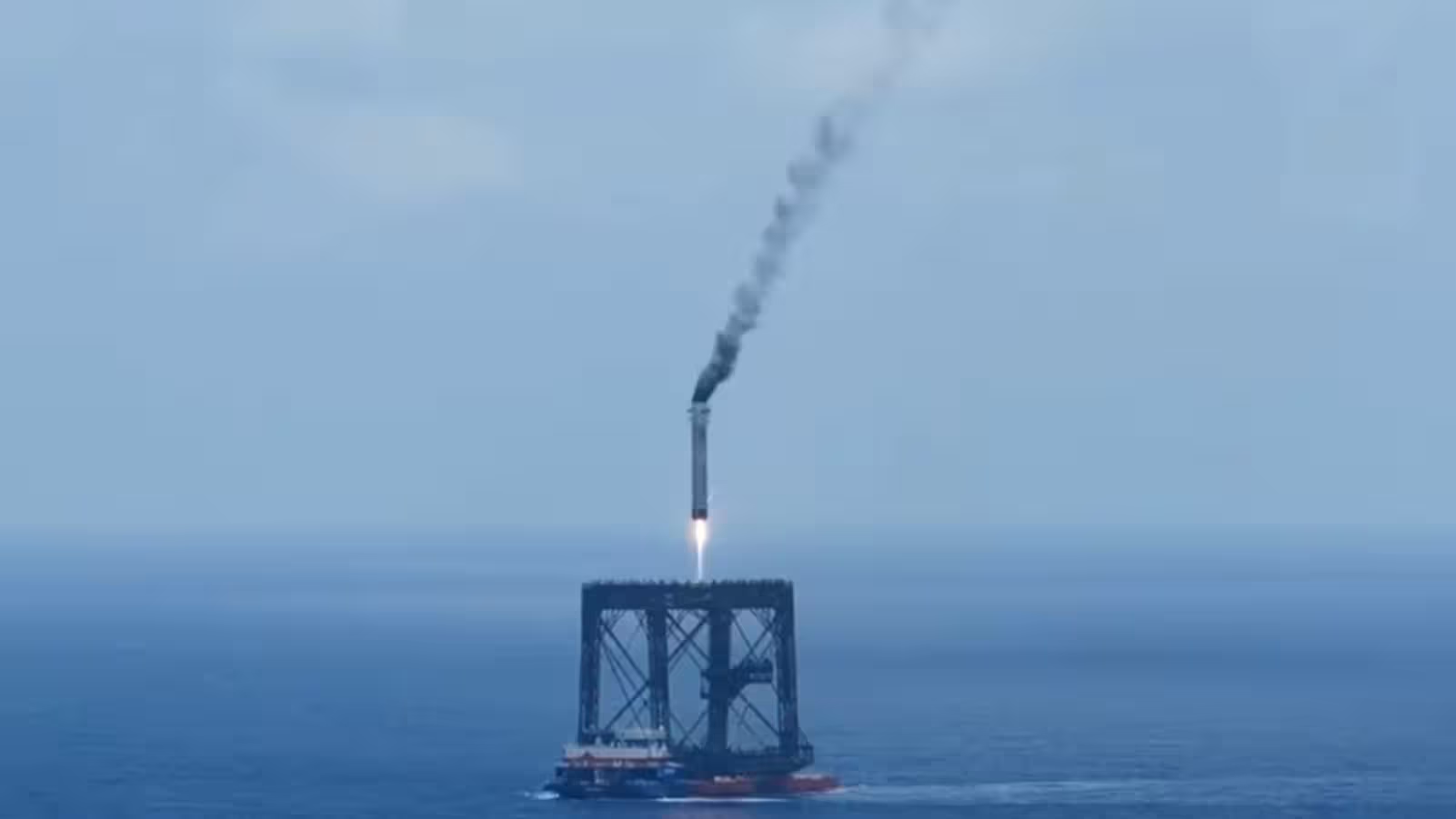
China has successfully completed its first orbital-class rocket booster recovery, marking the country’s biggest breakthrough in reusable rocket technology. The Long March 10B rocket safely returned its first-stage booster to an offshore recovery platform, making China one of the few nations capable of recovering an orbital-class reusable rocket. The achievement strengthens China’s commercial space ambitions, supports future lunar missions before 2030, and intensifies competition with SpaceX in reusable launch systems.
The Long March 10B Mission and Recovery Process
The historic flight took place at the Wenchang Spacecraft Launch Site, located within the Hainan commercial space launch complex in southern China.
The Long March 10B, a medium-lift vehicle designed for commercial aerospace and future lunar missions, lifted off on Friday, demonstrating a sophisticated sequence of maneuvers. Approximately six minutes after the separation of the upper stage and the booster, the first-stage booster began its descent.
Unlike the autonomous landing legs utilized by SpaceX’s Falcon 9, the Long March 10B employed a unique retrieval method. The booster utilized “landing hooks” to snag a specialized net attached to a sea-based platform. This net-capture system allowed the booster to be caught and stabilized, ensuring a controlled recovery rather than a traditional propulsive landing on a hard deck.
Long March 10B Specifications, Payload Capacity and Lunar Mission Role
The Long March 10B stands 63 meters tall and is designed by the China Academy of Launch Vehicle Technology to carry at least 16 metric tons to low-Earth orbit (LEO). This capacity allows China to combine heavy-lift capabilities with the economic advantages of reusable rocket technology.
The Long March 10 family is being developed to support China’s planned crewed lunar missions before 2030. Data gathered from the Long March 10B’s recovery flight will provide critical validation for technologies required to sustain long-term lunar exploration and the transport of personnel and equipment to the Moon.
Also Read – China Tests Nuclear-Capable Missile in South Pacific, Australia Warns of Regional Security Risks
China Reusable Rocket vs SpaceX: How the Long March 10B Compares
For years, the United States—led primarily by SpaceX—has maintained a virtual monopoly on orbital-class reusability. SpaceX achieved its first orbital flight recovery in December 2015, and the Falcon 9 now launches approximately 150 times per year, with individual boosters reused dozens of times. More recently, Blue Origin’s New Glenn entered the fray in November 2025.
China’s success comes after nearly a decade of iterative development, moving from low-altitude hover tests to several unsuccessful orbital-class attempts. Last year, both the state-owned China Aerospace Science and Technology Corporation and the private firm LandSpace faced failures during the final landing phases of their recovery attempts.
Why China’s Reusable Rocket Matters for Commercial Space and Lunar Missions
The ability to reuse boosters significantly lowers the cost of launching satellites, which is essential for China’s rapidly expanding commercial satellite constellations. By reducing the capital expenditure required for each launch, China can accelerate its deployment of global communication and observation networks.
China plans to refurbish and relaunch the recovered Long March 10 booster before the end of 2026, marking the next step from successful recovery to reusable rocket operations.
Frequently Asked Questions
What is the Long March 10B rocket?
The Long March 10B is a Chinese medium-lift orbital rocket developed for commercial aerospace and crewed lunar missions. It stands 63 meters tall and can carry at least 16 metric tons to low-Earth orbit.
How does the Long March 10B recovery differ from SpaceX?
While SpaceX uses autonomous landing legs to touch down vertically on a pad or drone ship, the Long March 10B uses a system of landing hooks to be caught by a net attached to an offshore sea platform.
Why is reusable rocket technology important?
Reusability drastically reduces the cost of space access because the booster—the most expensive part of the rocket—does not have to be rebuilt for every mission. This enables more frequent launches and cheaper satellite deployments.
When did China achieve this recovery?
China successfully recovered the orbital-class booster of the Long March 10B on Friday, July 10, 2026, launching from the Wenchang Spacecraft Launch Site.
Will the recovered booster be used again?
Yes, according to reports from CCTV, China plans to reuse the Long March 10 booster stage for another launch before the end of 2026.
How does this affect China’s lunar goals?
The Long March 10 family is being developed to support China’s goal of sending humans to the Moon before 2030. The recovery and reuse of these rockets provide the technical data and cost-efficiency needed for such a massive program
Is the Long March 10B reusable?
Yes. China intends to refurbish and reuse the recovered Long March 10B booster, making it part of the country’s transition toward reusable launch systems.
News Sources – ABC News, Business Today