
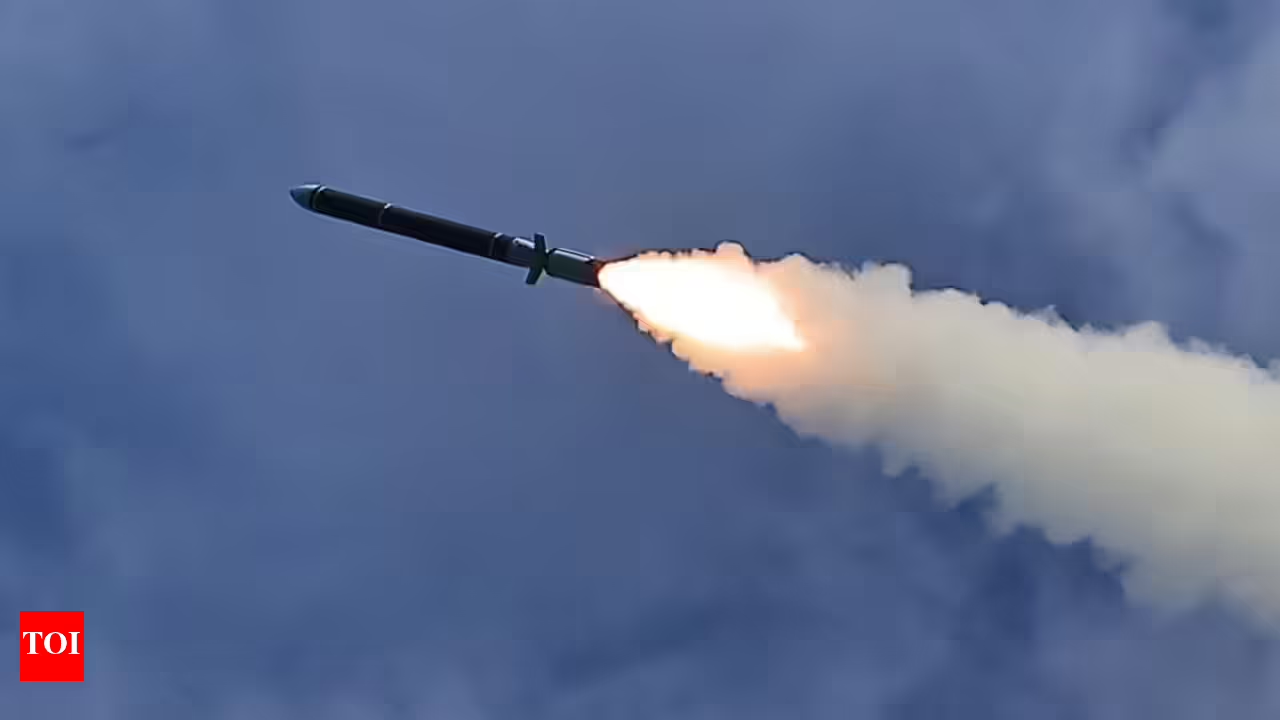
China launched a nuclear-capable intercontinental ballistic missile from a ballistic missile submarine into the South Pacific on Monday, prompting strong reactions from Australia, New Zealand, Japan, and other regional powers.
The missile involved a dummy warhead and landed within a designated target zone in the Pacific Ocean. While Beijing maintains the exercise was a routine part of annual training, the move has been condemned by regional powers as a destabilizing action that undermines the security and peace of the Pacific.
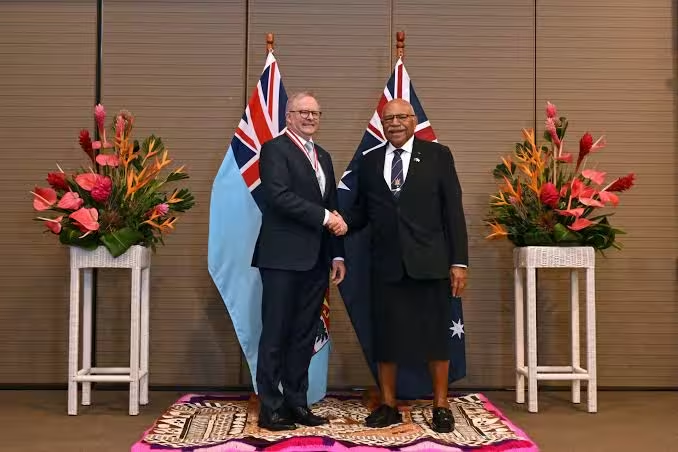
The incident is particularly significant, occurring just hours after Australia and Fiji formalized a high-level military pact intended to bolster security in the region.
Australia and Fiji’s New Defence Pact Amid Regional Tension
The timing of the missile test is highly contentious, as it broke only hours after Australia and Fiji announced the “Ocean of Peace Alliance.” This surprise military pact elevates the relationship between the two nations to the highest levels, introducing a mutual defence obligation. Under this treaty, either Australia or Fiji would be required to respond should the other come under military attack.
Australian Acting Prime Minister Richard Marles stated that while Australia was briefed by China regarding the planned test, the government remains “very concerned” about actions that undermine the stability of the region.
Foreign Minister Penny Wong emphasized that the move lacked the “transparency and reassurance” expected by Pacific neighbors. She noted that Pacific Islands Forum leaders have consistently advocated for the Pacific to remain an “ocean of peace,” a vision that this missile test directly contradicts.
Fiji’s Prime Minister Sitiveni Rabuka addressed the potential for Chinese backlash against the new pact, stating he did not expect severe pushback. Rabuka clarified that the alliance does not threaten Fiji’s relationship with China, asserting that “your enemies are not necessarily my enemies.”
Despite this, the contrast between the “Ocean of Peace” initiative and the launch of a strategic weapon was highlighted by Shadow Foreign Affairs Minister Ted O’Brien, who labeled the Chinese action “irresponsible.”
Also Read – Australia and Fiji Sign Historic Defence Treaty Under Ocean of Peace Alliance
Why China’s South Pacific Ballistic Missile Test Matters for Regional Security
The People’s Liberation Army (PLA) Navy confirmed the launch of the “strategic missile,” with a spokesperson, Senior Captain Wang Xuemeng, stating that the operation complied with international law and practice.
However, defense analysts suggest the test is a calculated demonstration of China’s evolving nuclear deterrent. According to experts, this launch signals that China’s nuclear capabilities are no longer solely reliant on land-based systems, but are now robustly mobile via its fleet of nuclear-powered ballistic missile submarines.
The scale of China’s militarization is becoming increasingly evident. Recent reports indicate that China possesses a fleet of six ballistic-missile submarines and 59 nuclear-powered attack submarines. Furthermore, data released by the Pentagon suggests that China’s nuclear stockpile reached approximately 600 warheads in 2024, with projections indicating the PLA is on track to field more than 1,000 nuclear warheads by 2030.
This rapid expansion of military hardware, coupled with a lack of transparency, has created significant uncertainty regarding Beijing’s long-term strategic intentions.
Violation of the South Pacific Nuclear Free Zone and Diplomatic Fallout
New Zealand has expressed “deep concern” over the test, with Foreign Minister Winston Peters noting that the missile was fired into the South Pacific Nuclear Free Zone. This zone was established by the 1986 Treaty of Rarotonga, which prohibits nuclear weapons in the region. China ratified these protocols in 1987, pledging not to test nuclear weapons within the zone or threaten signatories with them.
Minister Peters criticized the timing of the notification, revealing that New Zealand was only informed hours before the launch. He warned that such activities must not be allowed to become “normalised or routine,” suggesting that China is treating the South Pacific as a convenient testing site for its missile capabilities.
Japan has also voiced grave concerns, with Chief Cabinet Secretary Minoru Kihara stating that China’s military activities and lack of openness are a “grave concern for Japan and the international society.” The Japanese government urged Beijing to rethink its testing protocols to ensure projectiles do not fly over Japanese territory or pose additional security risks.
Similarly, NATO Secretary General Mark Rutte indicated that the test “sent a message” to the alliance, linking China’s assertive behavior to its role as a “key enabler” for Russia in the conflict in Ukraine.
International Response to China’s South Pacific Missile Test
While the Chinese Ministry of Foreign Affairs has dismissed the criticism and urged other nations to avoid “overinterpretation,” the international community remains skeptical. The discrepancy in notification—where Australia, Japan, and New Zealand were briefed, but the United States was not—suggests a targeted diplomatic signal from Beijing.
The shift toward submarine-launched intercontinental ballistic missiles (ICBMs) allows China to project power far beyond its coastal waters, increasing the survivability of its second-strike capability.
As China continues to modernize the PLA, the tension between its “no first use” nuclear policy and its aggressive expansion of weaponry continues to fuel anxiety across the Indo-Pacific region.
Frequently Asked Questions
What was the purpose of China’s recent missile test in the Pacific?
China stated the launch of the nuclear-capable intercontinental ballistic missile with a dummy warhead was part of routine annual training for the PLA Navy and was not directed at any specific country.
Why are Australia and New Zealand concerned about this test?
Both nations view the test as destabilizing to the region. New Zealand specifically highlighted that the test occurred within the South Pacific Nuclear Free Zone, established by the Treaty of Rarotonga.
What is the Ocean of Peace Alliance between Australia and Fiji?
It is a new mutual defense treaty and military pact that requires both countries to respond if the other is subjected to a military attack, aimed at strengthening security and countering foreign influence in the Pacific.
How does this test impact regional security?
The test demonstrates China’s ability to launch long-range nuclear weapons from submarines in the deep Pacific, signaling a shift in its nuclear deterrent strategy and increasing the risk of military miscalculation.
What is the projected growth of China’s nuclear arsenal?
According to Pentagon reports, China had approximately 600 nuclear warheads in 2024 and is expected to have more than 1,000 by the year 2030.


2 thoughts on “China Tests Nuclear-Capable Missile in South Pacific, Australia Warns of Regional Security Risks”