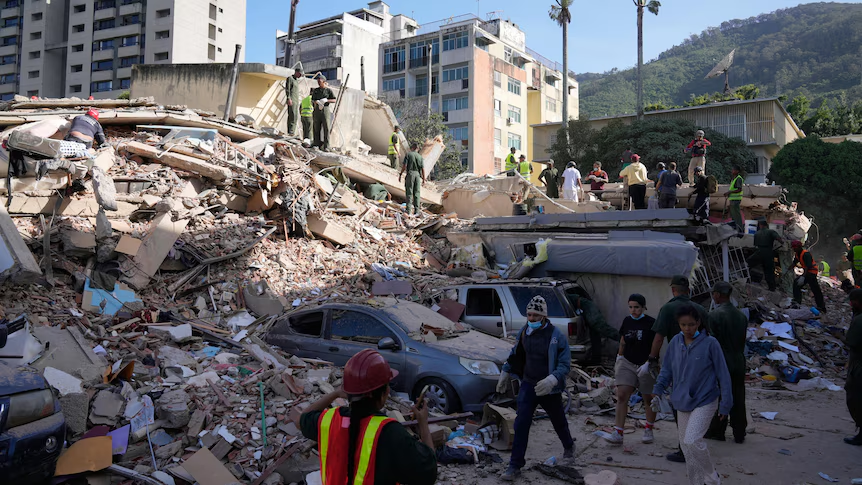
A powerful Venezuela earthquake struck the country on Wednesday evening, killing at least 164 people and injuring more than 971 others after twin tremors measuring 7.2 and 7.5 magnitude rocked the nation.
Officials warn that the death toll is expected to rise significantly as rescue operations continue. The dual seismic events, occurring less than a minute apart, triggered a national state of emergency, causing widespread building collapses and the closure of critical infrastructure.
Venezuela Earthquake Today: Key Facts
- Magnitude: 7.2 and 7.5
- Death Toll: 164+
- Injured: 971+
- Hardest-Hit Areas: La Guaira, Caracas
- Tsunami Warning: Cancelled
- State of Emergency: Active
Venezuela Earthquake Today: How the Rare Earthquake Doublet Unfolded
According to the US Geological Survey (USGS), the region was hit by what is known as an earthquake “doublet.”
The first tremor, a magnitude 7.2, struck just after 6:00 PM local time, with its epicenter located west of the community of Morón, approximately 168 kilometers from the capital, Caracas. This initial quake was categorized as a “foreshock.” Just 45 seconds later, a more powerful “mainshock” of magnitude 7.5 struck 16 kilometers southwest of Morón.
The depth of the tremors—roughly 10 to 13.2 kilometers—contributed to the intensity of the shaking felt on the surface.
These events represent the strongest seismic activity to strike the country in over a century. The power of the quakes was so immense that they were felt as far away as the Colombian border and the Amazon region of Brazil, nearly 1,700 kilometers from Caracas.
Venezuela Earthquake Damage in La Guaira and Caracas
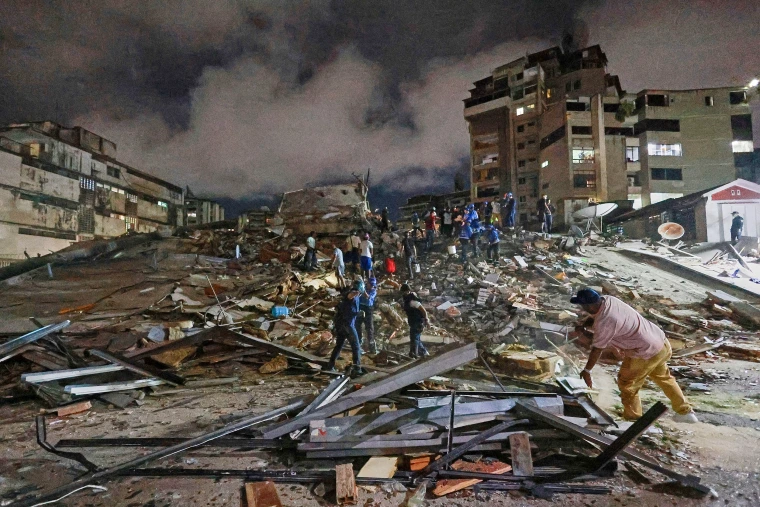
Interim President Delcy Rodríguez has officially declared the coastal state of La Guaira a “disaster zone,” citing it as one of the hardest-hit areas due to the sheer number of demolished structures.
In the capital, Caracas, the scene was described by survivors as a “horror movie,” with residents fleeing crumbling apartments and offices. Districts such as Altamira reported severe structural failures, while the San Juan Tadeo building in the El Paraíso urban development complex became a focal point for emergency rescue efforts.
The Simón Bolívar International Airport in Maiquetia, a vital transport hub near the capital, was forced to shut down after sustaining severe damage. Social media footage captured the chaos inside the terminal, showing debris falling from ceilings and passengers fleeing in panic as the facility shook violently.
Geophysicists suggest that the extreme damage in Caracas is partly due to the city’s location in a deep sedimentary basin, which amplifies seismic waves. Furthermore, much of the country’s informal housing and older buildings were not constructed to withstand such high-magnitude tremors, making them highly vulnerable to total collapse.
Rescue Operations and International Humanitarian Aid
Emergency responders, firefighters, and military personnel are currently scouring piles of shattered concrete and steel using power tools to locate survivors.
Interior Minister Diosdado Cabello emphasized that security forces are following strict protocols to prioritize the elderly and children, urging citizens to remain outdoors to avoid further injuries from ongoing aftershocks.
The international community has responded swiftly to the crisis. US President Donald Trump stated that the United States stands “ready, willing and able to help,” with Secretary of State Marco Rubio confirming the immediate deployment of search and rescue teams, medical resources, and humanitarian assistance.
Other nations, including Ecuador, El Salvador, the Dominican Republic, and Brazil, have also offered aid. Additionally, the United Nations is providing specialized personnel to support the recovery efforts.
To address the long-term devastation, President Rodríguez announced the establishment of a $US200 million fund dedicated to the reconstruction of vital infrastructure and housing for those displaced by the disaster.
Tectonic Vulnerability and Tsunami Warnings
While earthquakes are less frequent in Venezuela than along the “Pacific Ring of Fire” (such as in Chile or Mexico), the country’s position straddling the South American and Caribbean plates creates a massive strike-slip fault zone. This geological setting makes the region susceptible to sudden, violent seismic shifts.
Immediately following the tremors, the US-based National Tsunami Warning Centre issued an advisory for coastlines within 300 kilometers of the epicenter, including Aruba, Bonaire, Curacao, and potentially Puerto Rico and the Virgin Islands. However, this warning was swiftly rescinded after it was determined there was no longer a threat of hazardous waves.
Economic Impact and Infrastructure Crisis
Beyond the human tragedy, the economic fallout is expected to be severe. The USGS estimates that economic losses could range from 2% to 20% of Venezuela’s total GDP.
While key oil refineries near the Montalban municipality have not reported catastrophic failures, the nationwide disruption of power, gas, and telecommunications is complicating rescue efforts.
The timing of the disaster was particularly tragic, as the earthquakes struck during a public holiday commemorating the 1821 victory in the war of independence from Spain. With many families gathered at home, the impact on residential casualties was amplified.
Frequently Asked Questions
What was the magnitude of the earthquakes in Venezuela?
Venezuela was hit by two powerful earthquakes: a magnitude 7.2 foreshock followed 45 seconds later by a magnitude 7.5 mainshock.
Which areas were hardest hit by the tremors?
The coastal state of La Guaira has been declared a disaster zone, and the capital city of Caracas suffered extensive building collapses and infrastructure damage.
Is there currently a tsunami threat?
No. Although a tsunami advisory was initially issued for the Caribbean region and nearby islands, it has since been rescinded by the National Tsunami Warning Centre.
What is the estimated death toll from the quakes?
The Venezuela earthquake death toll currently stands at 164, though officials fear the number could rise as rescuers continue searching collapsed buildings. The USGS predictive modeling suggests the total casualties could be significantly higher, with a substantial probability of exceeding 10,000 people.
How is the international community assisting Venezuela?
The United States is deploying search and rescue teams and medical aid, while the UN is providing specialized personnel and several Latin American nations have offered humanitarian support.
News Sources – Nine, Al Jazeera