
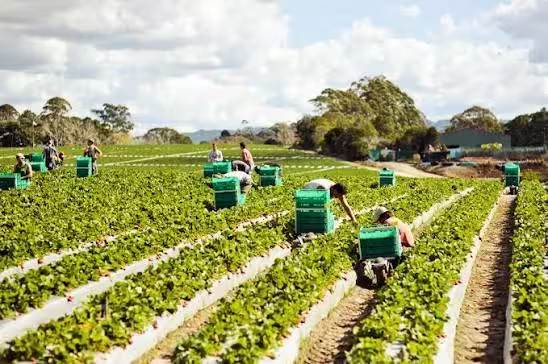
Australia’s horticulture production value reached a record $19.5 billion in the 2024/25 financial year, according to the latest Australian Bureau of Statistics (ABS) agricultural production data.. The industry’s value has nearly doubled over the past decade, driven by strong growth in fruit and nut production and expanding export markets.
Despite the record performance, many growers continue to face rising production costs and volatile farmgate prices, meaning higher industry value has not always translated into stronger profits.
What Is Australia’s Current Horticulture Production Value?
Australia’s horticulture industry reached a record $19.5 billion in 2024–25, according to the Australian Bureau of Statistics (ABS) agricultural production data. The increase was driven by strong growth in fruit, nut, and vegetable production, particularly almonds, avocados, citrus, and potatoes.
Why Australia’s Horticulture Production Reached a Record $19.5 Billion
The climb to $19.5 billion is not the result of a single factor but rather a combination of increased crop volume and strategic expansion.
Lucy Noble, head of industry insights at Hort Innovation, highlights that a significant portion of this growth is tied to “the actual crop in the ground,” particularly within perennial tree crops. Avocados and almonds have emerged as powerhouse contributors to this growth.
The nut industry, specifically almonds, has seen a remarkable ascent, reaching a record value of $1.3 billion—a substantial increase of 19.6 per cent.
This growth is largely attributed to a strong recovery in export volumes, allowing Australian growers to capitalize on international demand. Similarly, the fruit sector saw its domestic value rise by 6.1 per cent to reach $7.3 billion.
This growth was seen across a diverse range of products, from mature staples like citrus and berries to emerging high-value crops such as papaya and passionfruit.
Australia’s Horticulture Export Markets Continue to Expand
A critical component of the record-breaking horticulture production value is the industry’s commitment to diversifying its trade partners. Historically, the vast majority of Australian horticulture has served the domestic market, with only 10 to 15 per cent of produce being exported.
However, there has been a concerted effort to break into new territories to reduce reliance on a few key markets.
Australia has successfully broadened its reach into several high-growth Asian markets, including:
- India: A massive emerging market for premium Australian produce.
- Vietnam: Increasing demand for high-quality fruits.
- Japan: A long-standing partner with a preference for premium standards.
- Hong Kong: A vital hub for redistribution and luxury produce.
By investing in these critical relationships, the industry has ensured that there are diverse destinations for a wide array of produce, protecting the sector from localized economic downturns or trade disputes in any single region.
Australian Vegetable Production Also Shows Strong Growth
The vegetable sector has also contributed significantly to the national total, with its local value rising 5.6 per cent to reach $6 billion. Within this category, potatoes remain a dominant force, accounting for $1.2 billion of the total value. However, growth is not limited to traditional staples.
Industry analysts have noted an uptick in “emerging” categories, such as capsicums, as well as steady performance from head lettuce and pumpkins. This suggests that growers are becoming more agile, adapting their planting schedules and crop choices to meet changing consumer preferences and market gaps.
Why Higher Horticulture Production Value Doesn’t Mean Higher Farmer Profits
Despite the record-breaking numbers, a persistent disconnect remains between the total value of the horticulture sector and the actual take-home pay for many growers. The “value” of the crop refers to the gross worth, but this does not account for the escalating costs of production.
Many farmers are grappling with rising input costs, including fertilizers, fuel, and wages. For some, the increase in production value is simply offsetting these higher overheads rather than increasing their net profit.
Furthermore, profitability varies wildly depending on the specific crop, the region of production, and the seasonal weather conditions.
For example, growers in North Queensland have benefited from warmer-than-usual winter nights, which have accelerated the ripening of tomatoes and capsicums. However, these growers often face the challenge of “farmgate price variability.”
To combat this, some farmers are shifting toward direct-to-consumer models. By bypassing traditional middlemen, they can secure more stable pricing and mitigate the risk of drastic price drops that often occur during peak harvest gluts.
How Consumer Demand Is Shaping Australia’s Horticulture Industry
The domestic market continues to play a pivotal role in shaping the industry. While exports drive the high-value growth, the domestic consumer’s expectation for affordable produce creates a ceiling for certain vegetable types.
Growers note that certain staple vegetables must remain on the “cheaper end” because that is what consumers are accustomed to paying.
To remain sustainable, the industry is focusing on efficiency and tailoring produce to suit modern eating styles. The goal is to balance the need for high-volume, affordable staples with the development of premium, niche products that can command higher prices both at home and abroad.
Frequently Asked Questions
Which crops contributed most to the record growth in horticulture?
Fruit and nut industries led the growth, with almonds reaching a record $1.3 billion value. Avocados, citrus, berries, and potatoes were also significant contributors.
Why isn’t the record production value resulting in higher profits for all farmers?
While the overall value of the industry has increased, rising costs of inputs (such as wages and materials) and price variability at the farmgate have eaten into the profit margins for many individual producers.
Which international markets is Australia targeting for horticulture exports?
Australia has been diversifying its export footprint by expanding relationships and market access in India, Vietnam, Hong Kong, and Japan.
How much of Australia’s horticulture produce is exported?
The majority of Australian horticulture serves the domestic market, with approximately 10 to 15 per cent of production being exported.
News sources – ABC News