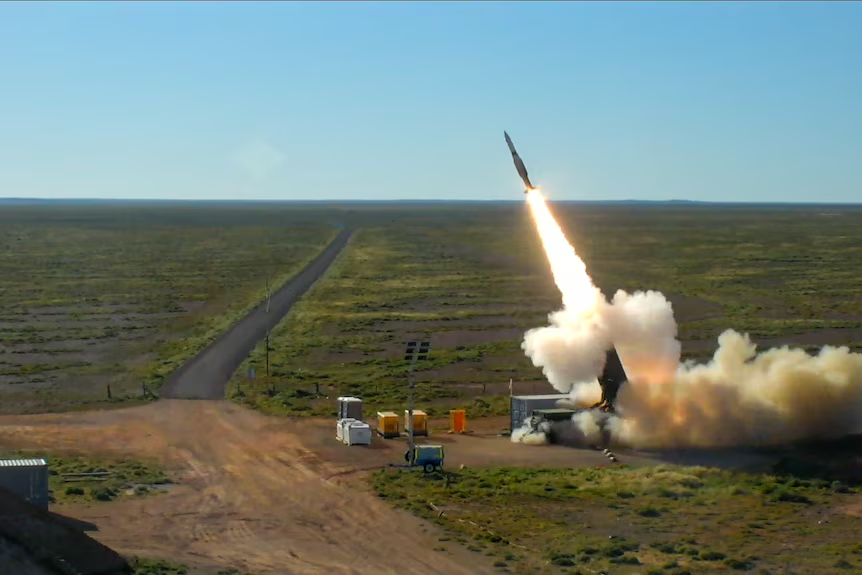
During Exercise Taipan Strike 2026, the Australian Defence Force (ADF) successfully completed a missile interceptor test, marking a major step in strengthening Australia’s national air and missile defence capabilities. The ADF intercepted a cruise missile using a prototype ground-based missile defence system at the Woomera testing range in South Australia, supporting the country’s long-term plan to build an integrated air and missile defence network.
Why Australia Is Expanding Its Integrated Air and Missile Defence Network
The push for a more robust integrated air and missile defence strategy comes amid a shifting geopolitical landscape in the Indo-Pacific. The Australian government is prioritizing the development of a medium-range ground-based air defence system to counter the evolving threat of long-range missiles and sophisticated aircraft.
According to the 2026 Integrated Investment Plan, the Australian government intends to spend between $7 billion and $10 billion over the next decade to enhance these capabilities. This investment aims to ensure that Australia can independently monitor, track, and neutralize threats before they reach critical infrastructure or population centers.
Defence Minister Richard Marles emphasized that the recent test is a practical demonstration of Australia’s commitment to growing its sovereignty while collaborating with international partners and local industries.
Technical Specifications of Australia’s Missile Interceptor Test
The successful interception during Exercise Taipan Strike 2026 utilized a sophisticated blend of multi-national technology. The primary weapon used was the Standard Missile-2, a reliable interceptor with a range of up to 166 kilometres, which is already employed by the Royal Australian Navy.
For this ground-based test, the missile was launched from a Derringer trailer-mounted Expeditionary Launch System, an American-made piece of equipment.
A key component of the success was the integration of an Australian radar system, which provided the precise guidance necessary to track and take down a US Navy BQM-74E target drone. This integration proves that Australian-made sensor technology can effectively communicate with foreign launch systems to create a cohesive defensive shield.
How China’s ICBM Test Influenced Australia’s Missile Defence Strategy
The timing of the test and the subsequent release of imagery are closely linked to rising tensions in the South Pacific. Recently, China test-fired a nuclear-capable intercontinental ballistic missile (ICBM) in the region, a move that drew widespread condemnation from the United States, New Zealand, and Australia.
The Chinese missile test has highlighted vulnerabilities in regional defences and sparked a domestic political debate regarding the pace of Australia’s military upgrades.
Shadow Defence Minister James Paterson has expressed concern that the current speed of procurement may not be sufficient to counter the high-speed, long-range capabilities demonstrated by adversaries. He argued that without an accelerated investment in an integrated network, Australia may struggle to intercept advanced ballistic threats.
Future Outlook for Australian Defence Capability
Air Marshal Stephen Chappell, Chief of the Air Force, noted that the Woomera exercises are designed to explore various medium-range air defence options to inform future acquisition decisions. The goal is to move beyond prototypes and roll out these systems in strategically significant areas across the country.
Beyond the interceptor tests, Australia is making strides in domestic manufacturing. Recent footage has revealed the first successful test-firing of a locally made solid rocket motor, signaling a shift toward greater industrial independence. By reducing reliance on foreign supply chains for critical components, Australia aims to increase its agility and resilience in the face of emerging security challenges.
Frequently Asked Questions (FAQ)
Why did Australia conduct a missile interceptor test?
The test was designed to verify the effectiveness of a ground-based air defence system in intercepting incoming cruise missiles, serving as a prototype for a national missile defence network.
What technology was used in the interceptor test?
The ADF used a Standard Missile-2 launched from an American Derringer Expeditionary Launch System, guided by an Australian-made radar system.
How much is Australia investing in missile defence?
The Australian government plans to spend between $7 billion and $10 billion over the next ten years on integrated air and missile defence.
Why is this test significant in the context of China?
The test follows a Chinese nuclear-capable ICBM test in the South Pacific, highlighting the need for Australia to develop capabilities to counter long-range and high-speed missiles.
Where did the live-fire exercise take place?
The tests were conducted at the Woomera testing range in South Australia during Exercise Taipan Strike 2026.
What is the range of the Standard Missile-2?
The Standard Missile-2 has an operational range of up to 166 kilometres.
News Sources – ABC News