
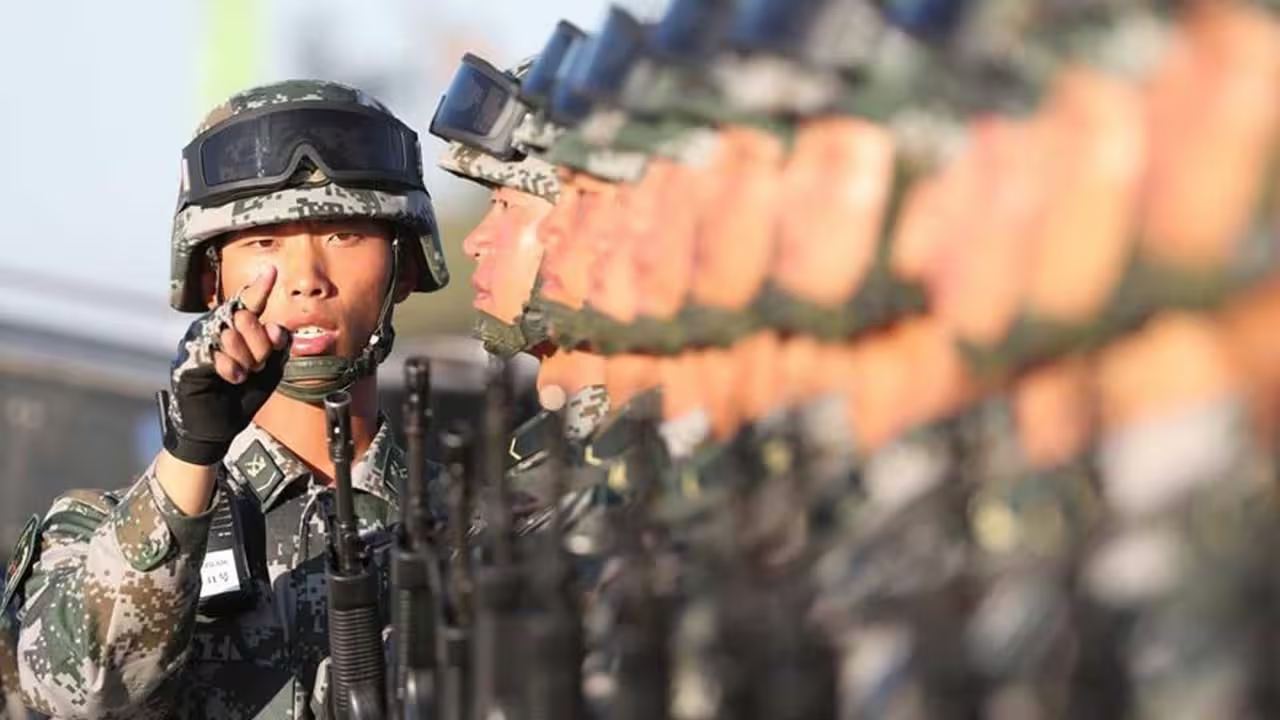
A comprehensive new analysis from the Lowy Institute has revealed that China possesses a “real and growing” capability to launch direct missile strikes against the Australian mainland, marking a historic shift in the nation’s security landscape. The report underscores that while Beijing’s focus has traditionally remained closer to its own borders, the scale of the People’s Liberation Army (PLA) build-up now allows China to threaten critical Australian infrastructure, subsea communications cables, and vital maritime trade routes. For Australians, this shift necessitates a critical re-evaluation of national defence strategies as the ability of an external power to project force into the Southern Hemisphere accelerates.
What Happened?
The Lowy Institute, Australia’s leading foreign policy think tank, has released a detailed report tracking the rapid militarisation of the Chinese People’s Liberation Army (PLA). The analysis focuses strictly on military capabilities rather than predicting political intentions or the likelihood of conflict. However, the findings are blunt: China’s military expansion is not merely regional but is evolving to include long-range projection capabilities that can reach the Australian continent.
According to the report, the threat is multi-faceted. It ranges from the immediate ability to disrupt the digital and economic arteries of the nation to the developing capacity for kinetic strikes on land. The research highlights a “dramatic” scale of build-up, describing it as the most significant challenge to Australian security since the end of the Cold War.
Why It Matters to Australia
This news is of paramount importance to Australians because it challenges the long-held assumption of “geographic insulation.” For decades, Australia’s distance from global conflict zones provided a natural buffer. That buffer is effectively eroding.
The implications for the Australian public and government are profound:
- Economic Security: Australia relies heavily on maritime trade. The report warns that China could block trade routes through the Indonesian archipelago, potentially crippling the economy.
- Digital Sovereignty: Our commerce and personal communications depend on undersea cables. These are now identified as vulnerable targets that could be severed by Chinese naval assets.
- Infrastructure Vulnerability: Beyond missiles, the report highlights the risk of sophisticated cyber operations targeting critical Australian infrastructure.
- National Sovereignty: The potential for direct strikes on northern Australia changes the calculus for domestic defence spending and the placement of military assets.
Also Read – US Iran reached historic peace deal to reopen Strait of Hormuz, after months of conflict
Key Details and Developments
The report identifies several specific weapon systems and strategic moves that contribute to this growing risk. The most pressing threats involve ballistic missiles and the strategic use of “artificial islands” in the South China Sea.
The Missile Threat Matrix
China’s arsenal is diversifying in ways that specifically threaten the Australian mainland:
- DF-26 Missile System: These intermediate-range ballistic missiles can strike northern Australia if launched from China’s man-made islands in the South China Sea.
- DF-27 Missile: With an estimated range of 5,000 to 8,000 kilometres, this system significantly extends Beijing’s reach.
- Conventional ICBMs: There is growing speculation and reporting from the Pentagon that China has developed intercontinental ballistic missiles armed with non-nuclear (conventional) warheads.
- Sea-Based Strikes: The report confirms that China already has the capability to strike Australia using missiles launched from submarines and surface ships.
Naval and Aerial Expansion
The PLA Navy is no longer a coastal force. The report notes that China is rapidly improving its nuclear-powered submarine capabilities through the construction of modern shipyards. The recent circumnavigation of Australia by the PLA Navy serves as a clear signal of their ability to project power far from home. Furthermore, the development of more advanced aircraft carriers allows Beijing to maintain a persistent military presence in the region.
Aerial threats are also evolving. While not yet fully deployed, the report points to the potential development of the H-20 long-range bomber and advanced drone systems capable of reaching Australia. The emergence of these assets would represent a quantum leap in China’s strike capacity.
Impact on Australians
The findings of the Lowy Institute report have immediate and long-term implications across various sectors of Australian society.
Government and Defence Policy
The federal government, led by Prime Minister Anthony Albanese, has previously focused its military strategy on “deterring adversaries from northern approaches.” However, this report suggests that the threat is more direct than previously acknowledged publicly. There is now increased pressure on the Department of Defence to address “direct strike” scenarios, which may lead to shifts in the Defence Strategic Review and increased investment in missile defence systems.
The Pacific Diplomacy “Permanent Contest”
The report highlights a critical geopolitical flashpoint: the South Pacific. Australia is currently locked in what the Foreign Minister describes as a “permanent contest” to prevent China from establishing a military base in Pacific Island nations. If China were to secure a base in the Pacific, the report warns that the threat would “dramatically escalate,” potentially bringing central Australia—including major population centres—within range of bombers and missiles.
Industry and Economy
Australian businesses, particularly those in the shipping, logistics, and technology sectors, face systemic risks. The possibility of “choke points” being closed in the Indonesian archipelago could lead to supply chain volatility and increased insurance premiums for Australian shipping. Similarly, the vulnerability of subsea cables poses a risk to the financial services and telecommunications sectors in cities like Sydney, Melbourne, and Brisbane.
Expert Analysis and Outlook
Sam Roggeveen, Director of the Lowy Institute’s International Security Program, emphasises that this analysis is not intended to be alarmist but is a necessary “reality check.” He argues that the growth of the PLA is the most critical security development for Australia since the collapse of the Soviet Union.
Experts suggest that China’s primary goal is the construction of a “sphere of influence” in Southeast Asia. By increasing its military pressure, Beijing may force Southeast Asian nations to accommodate Chinese preferences, effectively isolating Australia and its partners. This strategy is designed to erode the cohesion of US-led security arrangements and undermine the credibility of “extended deterrence” provided by the United States.
The outlook suggests a decade of increasing tension. As the DF-27 and other long-range assets enter service in larger numbers, Australia’s “strategic depth” continues to shrink. The focus will likely shift toward enhancing regional partnerships and diversifying trade routes to mitigate the impact of potential maritime blockades.
What Happens Next?
In the coming months and years, several key triggers will determine the trajectory of Australian security:
- The H-20 Bomber: Security analysts are watching for photographic evidence of the H-20 bomber “breaking cover.” Its official induction would significantly alter the aerial threat profile.
- Pacific Basing Agreements: The Australian government will continue to increase diplomatic and economic engagement with Pacific Island nations to ensure no military footholds are granted to the PLA.
- Defence Procurement: Expect an increased focus on long-range strike capabilities and integrated air and missile defence (IAMD) systems for the Australian Defence Force (ADF).
- Cyber Resilience: A push for greater redundancy in undersea cable networks and hardened critical infrastructure to protect against hybrid warfare.
Conclusion
The revelation of a growing China missile threat to Australia serves as a wake-up call for the nation’s strategic planners and the general public. While diplomatic relations remain a priority, the Lowy Institute’s findings make it clear that capability and intent are two different things. Australia must maintain a “laser-like focus” on the evolving capabilities of the PLA to ensure the nation remains secure in an increasingly volatile Indo-Pacific region.
Whether through the deployment of DF-26 missiles from the South China Sea or the potential for new bases in the Pacific, the reality of a direct strike capability is no longer a theoretical exercise. Australia’s security now depends on a combination of robust defence investment, strong alliances, and a transparent public discussion about the risks facing the mainland.
Frequently Asked Questions
Can China actually hit Australia with missiles?
Yes, according to the Lowy Institute, China can already strike Australia using missiles launched from ships and submarines. Additionally, the DF-26 missile system can reach northern Australia if launched from artificial islands in the South China Sea.
What is the DF-27 missile and why is it a threat?
The DF-27 is an intermediate-range ballistic missile with an estimated range of 5,000 to 8,000 kilometres. This range allows it to potentially reach the Australian mainland directly from mainland China.
How does China’s military build-up affect the Australian economy?
Beyond direct strikes, China has the capability to intercept maritime trade routes (particularly through Indonesian choke points) and sever subsea communications cables, both of which are vital for Australian commerce and the digital economy.
Is Australia in one of the “high risk” zones for a direct attack?
While the report does not predict an attack, it notes that northern Australia is currently the most vulnerable to existing missile systems like the DF-26. However, if China secures a base in the Pacific or deploys H-20 bombers, central Australia would also come within range.
What is the Australian government doing to prevent this?
The Albanese government is engaged in a “permanent contest” to prevent China from establishing military bases in Pacific Island nations and has reshaped its military strategy to focus on deterring adversaries from northern approaches.
What is the difference between military “capability” and “intent”?
Capability refers to the physical tools (missiles, bombers, ships) a country possesses to carry out an action. Intent refers to whether they actually plan to use those tools. The Lowy Institute report focuses on what China can do, not necessarily what it will do.



2 thoughts on “China Can Now Strike Australian Mainland: Lowy Institute Warns”