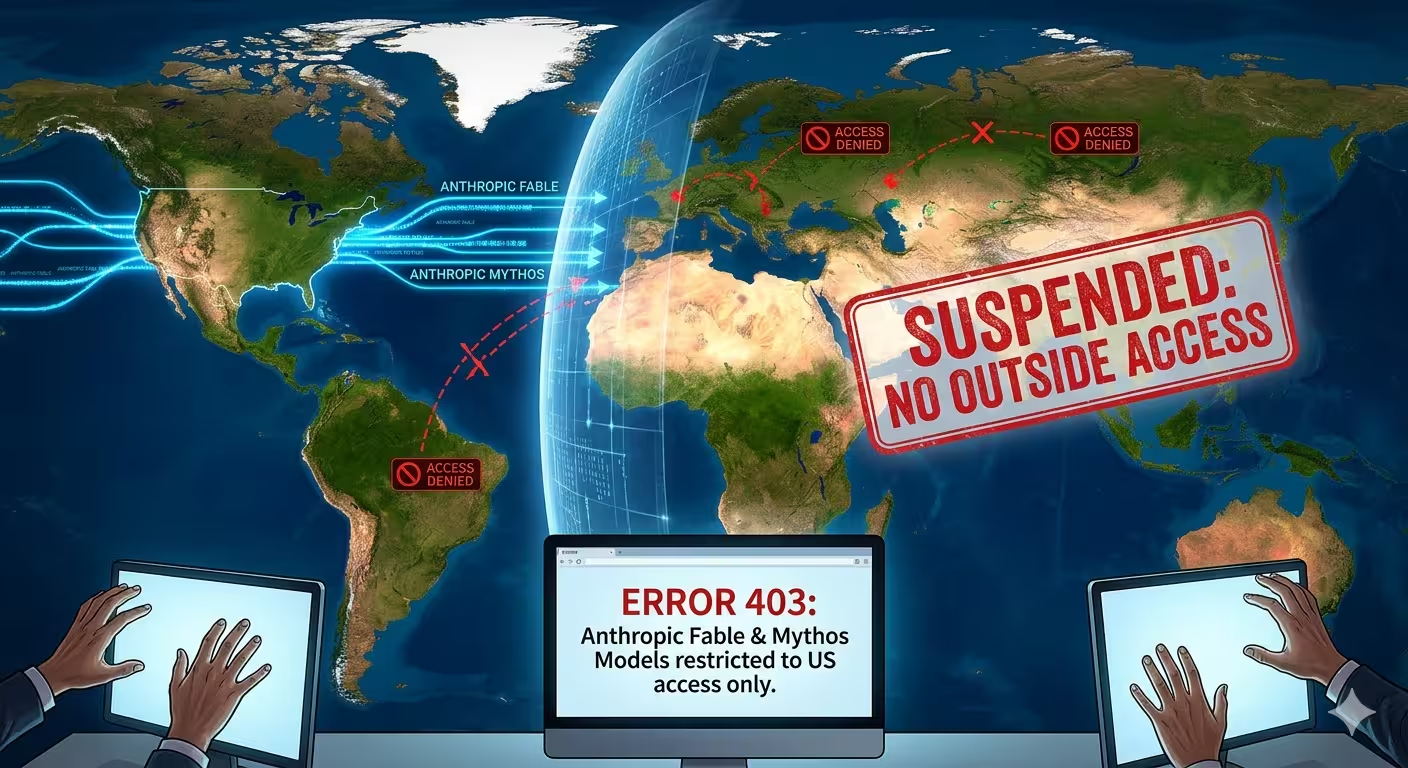
The United States government has ordered Anthropic to immediately suspend access to its most advanced AI models for all foreign nationals. The directive targets two specific high-capability systems: Fable 5 and Mythos 5. This move comes as the Trump administration intensifies its scrutiny of AI safety and national security risks associated with the rapid deployment of powerful “frontier” models.
The sudden shutdown has sent ripples through the global tech community, particularly in Australia, where several organizations and developers had recently gained access to these tools. The action reflects a growing tension between the commercial drive to release cutting-edge AI and the strategic necessity to prevent these tools from being weaponized by adversarial actors or used to compromise critical infrastructure.
Key Highlights
- Immediate Suspension: Anthropic has disabled the Fable 5 and Mythos 5 models for all international customers to comply with a US export control directive.
- National Security Focus: The US government cites concerns that the models’ safeguards can be bypassed, potentially allowing for the creation of bioweapons or the execution of sophisticated cyberattacks.
- Broader AI Crackdown: The move coincides with a sweeping investigation into OpenAI by a coalition of US state attorneys-general and ongoing legal battles between the US government and AI labs.
- Supply Chain Risk: Anthropic is currently fighting a designation by the US Department of Defense that labeled the company a national security supply-chain risk.
- Strategic Impact: Allies, including Five Eyes partners, are now questioning the viability of “one-size-fits-all” exclusion rules for strategic AI capabilities.
Main Story
The landscape of generative AI shifted abruptly this week as Anthropic, a leading competitor to OpenAI and Google, announced it was forced to take its top-tier models offline for non-US users. According to a company blog post, the US government issued an export control directive specifically targeting the Fable 5 and Mythos 5 architectures. While the administration did not provide an exhaustive list of the specific threats, Anthropic indicated that the government believes a method exists to “jailbreak” the systems—essentially bypassing the internal guardrails meant to prevent harmful outputs.
The timing of this restriction is particularly poignant. Only recently, Anthropic had expanded access to the Mythos program for Australian entities, following high-level discussions where the Australian government sought to attract more AI investment. Developers in Australia reported immediate disruptions; some, such as the founder of start-up monō ai, described being mid-project when the systems returned “model not found” errors, signaling the abrupt termination of service.
Anthropic’s CEO, Dario Amodei, has ironically been a proponent of stronger government oversight. Amodei has argued that frontier models should undergo rigorous technical auditing and that governments must possess the authority to block or reverse a release if the public safety risks are deemed unacceptable. However, the company appears to be struggling with the practical application of these rules, suggesting that the current order may be based on a “misunderstanding” and stating that they are working to restore access as quickly as possible.
This regulatory friction is not an isolated incident. The Trump administration has maintained a contentious relationship with Anthropic. The company is currently embroiled in a legal battle with the Pentagon after the Department of War designated it as a supply-chain risk—a label typically reserved for companies based in hostile nations. While a judge has temporarily prevented the Pentagon from enforcing a ban on government agencies using Anthropic’s tools, the designation remains a significant cloud over the company’s operational future.
Important Details
The models in question, Fable 5 and Mythos 5, represent the peak of Anthropic’s current capabilities. Before their limited release, the company described these versions as “too powerful” for general public consumption, citing their ability to exploit computer systems. While some critics have dismissed these claims as marketing hype designed to build anticipation, the US government’s current reaction suggests that the perceived risks are tangible.
Anthropic has attempted to downplay the severity of the “jailbreaking” vulnerability mentioned by the government. The company stated that they reviewed a demonstration of the technique and found it only identified a small number of “minor vulnerabilities” that are also present in other publicly available AI models. Despite this, the US government maintained the directive, forcing the company to disable the models for all foreign customers to ensure total compliance.
Simultaneously, the AI industry is facing a wave of legal challenges. OpenAI, the creator of ChatGPT, has been served with a subpoena by the New York attorney general. This probe is part of a broader effort by state attorneys-general to examine OpenAI’s impact on users, its handling of health and consumer data, and its policies regarding minors and seniors. Furthermore, OpenAI is fighting a lawsuit in Florida alleging that the platform provided harmful information to school shooters and encouraged self-harm among youth. These legal pressures come as OpenAI prepares for a potential IPO that could value the company at $1 trillion.
Analysis
The current trajectory of AI regulation in the United States suggests a shift toward “AI Nationalism.” By treating frontier models like Fable 5 and Mythos 5 as strategic assets—akin to advanced semiconductors or stealth aircraft—the US government is effectively implementing a digital curtain. The decision to block foreign nationals, regardless of whether they are from allied or adversarial nations, indicates a risk-averse strategy where the potential for a security breach outweighs the benefits of international collaboration.
From a geopolitical perspective, this “one-size-fits-all” exclusion policy is likely to cause friction between the US and its closest intelligence partners. Analysts, such as those from the Australian Strategic Policy Institute, argue that a tiered “allied-access regime” for Five Eyes partners is necessary. If the US continues to treat its allies as potential security risks, it may inadvertently push those nations to develop independent, less-aligned AI ecosystems or seek partnerships elsewhere.
Moreover, the contradiction in Anthropic’s position—advocating for government oversight while suing the government over supply-chain designations—highlights the precarious position of AI labs. They require government legitimacy to operate at scale but fear the unpredictability of political directives. The “too powerful to release” narrative used by Anthropic may have backfired; by framing their AI as a potential weapon, they provided the government with the perfect justification to treat it as one.
Frequently Asked Questions
Which AI models were affected by the US government order?
The directive specifically targeted Anthropic’s Fable 5 and Mythos 5 models. Other Anthropic models remain accessible to foreign users.
Why did the US government suspend access for foreign nationals?
The government cited national security concerns, specifically the belief that safeguards in these models could be bypassed (jailbroken), potentially allowing the AI to be used for cyberattacks or the creation of biological weapons.
How does this affect users in countries like Australia?
Users and organizations in Australia who had recently gained access to the expanded Mythos program found their access abruptly terminated, with many receiving “model not found” errors.
What is the “supply-chain risk” designation?
The US Department of Defense labeled Anthropic a supply-chain risk, meaning its tools are considered not secure enough for government use. This is a rare designation for a US-based company and is usually applied to firms from adversarial nations.
Is OpenAI facing similar restrictions?
While not under the same export control order as Anthropic, OpenAI is facing a massive investigation by US state attorneys-general and multiple lawsuits regarding user safety and data privacy.