
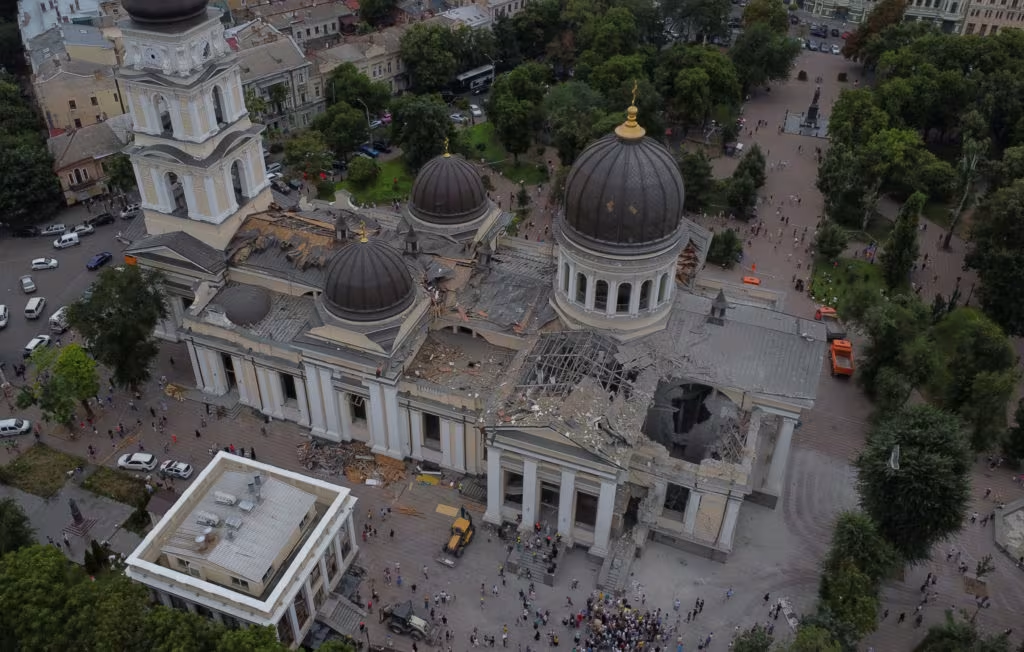
In what officials are describing as one of the most devastating aerial bombardments in months, Russian forces launched a massive wave of missiles and drones across Ukraine, resulting in the catastrophic fire at the 11th-century Dormition Cathedral. The cathedral is a central piece of the Kyiv-Pechersk Lavra monastery complex, a renowned UNESCO World Heritage site and a cornerstone of Ukrainian spiritual and cultural identity. The strikes, which targeted multiple cities including the capital and Kharkiv, have sparked international outrage and renewed calls for decisive air defense support for Ukraine.
The Assault on Kyiv and Cultural Heritage
The overnight attack on Monday saw Russia deploy a staggering 70 missiles and 611 drones. According to the Ukrainian military, air defense systems managed to intercept 50 missiles and 582 drones, though the sheer volume of the barrage led to significant breakthroughs.
In the heart of Kyiv, the Dormition Cathedral suffered a direct hit—identified by local authorities and security officers on the ground as being caused by a kamikaze drone. The impact tore a gaping hole in the structure and ignited a massive blaze that engulfed approximately 800 square meters of the roof.
The scene at the monastery was one of desperation and defiance. Monks and rescue workers formed human chains to save priceless liturgical relics and icons from the flames, while staff rang church bells in a symbolic gesture of resistance. Metropolitan Epiphanius, head of the Orthodox Church of Ukraine, condemned the strike as a “crime against humanity, history, and Christianity.” Similarly, Prime Minister Yulia Svyrydenko highlighted the hypocrisy of the attack, stating it revealed the “true face” of Russia’s claimed Orthodox values.
The destruction extended beyond the monastery. The Oleksandr Dovzhenko National Film Studios were also heavily damaged, resulting in the loss of an irreplaceable costume repository containing roughly 100,000 garments. In the civilian sector, strikes on residential high-rises in the Obolonskyi, Solomianskyi, and Pecherskyi districts left numerous residents wounded, including a pregnant woman and a child. The infrastructure damage was severe, with electricity lines failing and leaving approximately 140,000 Kyiv residents without power.
Casualties and the “Double-Tap” Tragedy in Kharkiv
Across Ukraine, the human toll has been grim. President Volodymyr Zelenskyy confirmed that at least 11 people were killed and 53 injured. While four deaths were recorded in the capital, a particularly brutal “double-tap” strike occurred in Kharkiv, Ukraine’s second-largest city. This military tactic involves hitting a target and then striking the same location minutes later to target the first responders who arrive to help.
In Kharkiv, five State Emergency Service rescue workers and a municipal official were killed when a second drone strike hit the site while they were extinguishing fires from an initial missile attack. Another five responders were injured in the blast. Additional strikes were reported in the Sumy region and Dnipro, further illustrating the widespread nature of the offensive.
Russian Denial and International Reaction
The Kremlin has denied any deliberate targeting of the Pechersk Lavra monastery. The Russian Ministry of Defence claimed its “precision weapons” were aimed solely at military-industrial facilities, conscription offices, and airbases. In a contradictory claim, Russian officials suggested that the cathedral was actually damaged by a malfunctioning US-made Patriot air defense missile—a claim debunked by Ukrainian security forces who found the remains of Shahed drones at the site.
The international community reacted with swift condemnation. French President Emmanuel Macron compared the attack to a strike on Notre Dame, asserting that “nothing justifies this attack on our universal heritage.” EU foreign policy chief Kaja Kallas labeled the targeting of civilians and UNESCO sites as “war crimes.” Ukraine’s Foreign Minister, Andrii Sybiha, announced that the government would urgently initiate procedures within UNESCO to ensure a formal international response to this “state barbarism.”
Diplomatic Maneuvering and Escalation
This escalation comes at a critical diplomatic juncture. President Zelenskyy has urged G7 leaders meeting in France to move beyond rhetoric and provide substantive support, specifically requesting more anti-ballistic missiles to counter Russia’s long-range capabilities. Both President Zelenskyy and President Vladimir Putin recently held separate phone calls with US President Donald Trump to discuss potential paths toward ending the conflict, which has now spanned over four years.
Simultaneously, Ukraine has intensified its own strategic strikes inside Russian territory to cripple Moscow’s revenue streams. A Ukrainian drone attack in Tula, an industrial hub south of Moscow, killed three people, including a one-year-old child. Furthermore, Ukraine targeted two bridges connecting the annexed Crimean peninsula to Russian-controlled areas, aiming to exacerbate an existing fuel crisis and sever supply lines.
The volatility of the region was further highlighted by Poland, a NATO and EU member, which scrambled fighter jets and put its air defenses on high alert due to the possibility of Russian airspace incursions during the barrage.
Conclusion
The attack on the Dormition Cathedral serves as a poignant reminder that in the current conflict, cultural and spiritual landmarks are no longer sanctuary zones. By targeting a UNESCO World Heritage site, Russia has not only caused physical destruction but has struck at the heart of Ukrainian national identity. As the G7 meets to discuss the war, the urgency for enhanced air defense systems has never been clearer, as Ukraine struggles to protect both its citizens and its timeless history from an increasingly systemic campaign of aerial terror.



One thought on “Russia Hits UNESCO World Heritage Site in Massive Kyiv Air Raid”